
Quality control is one of the most visible tools used to protect an order. Inspections, testing procedures and approval checkpoints help buyers identify defects before products are shipped. They are essential, especially when manufacturing is outsourced across long distances.
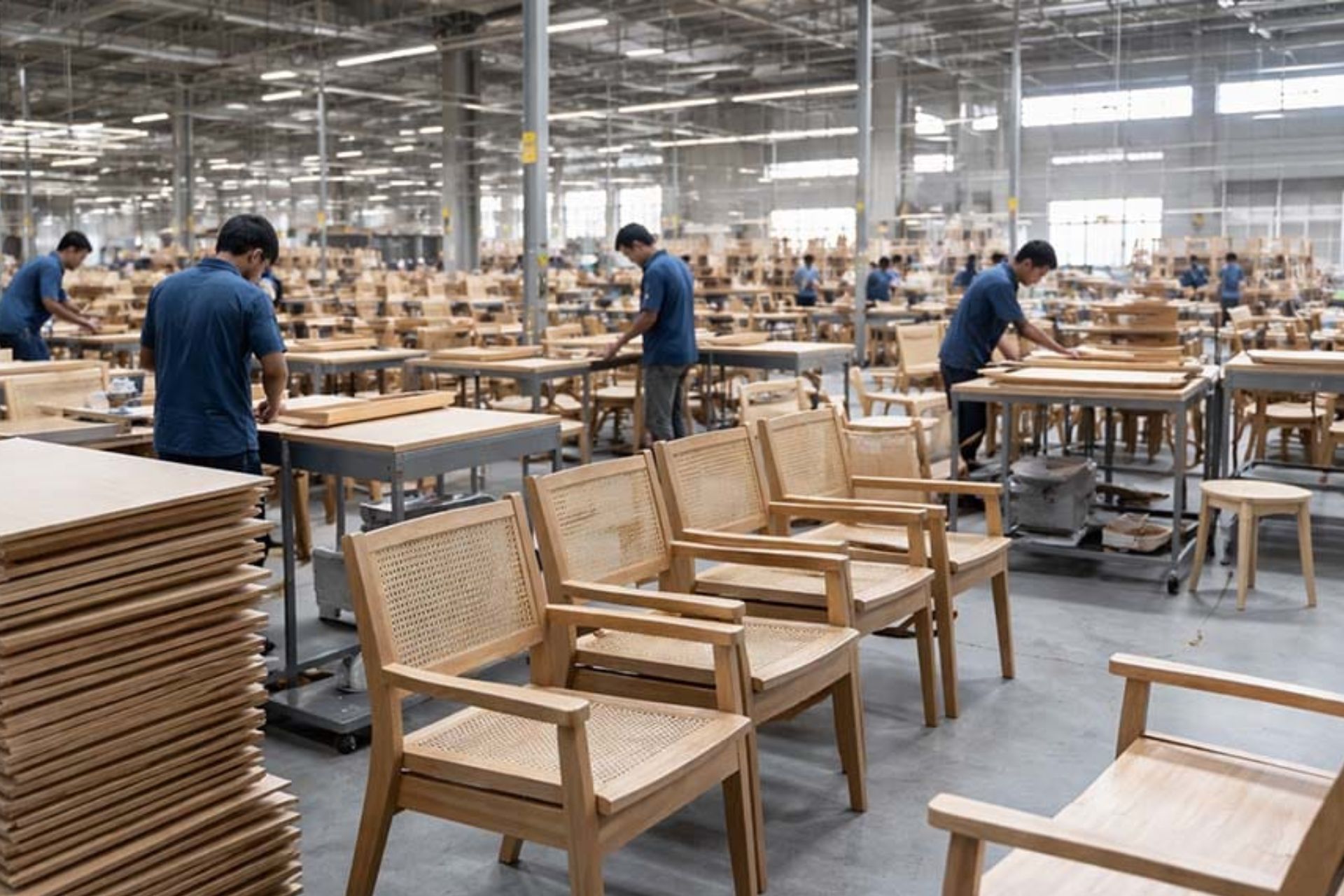
Yet a shipment can meet every technical requirement and still arrive late. A furniture manufacturer may produce approved samples and pass every inspection, but a delay in timber, hardware, upholstery materials or finishing can still disrupt the delivery schedule. Limited production capacity or an undisclosed subcontractor can create the same problem.
In furniture manufacturing, where multiple materials and processes must come together before a product is ready to ship, a delay at one stage can hold up the entire order.
This is where a supplier resilience strategy becomes important. Its purpose is to protect continuity when conditions change. Instead of looking only at product conformity, the buyer also examines whether the wider operation can absorb disruption, adjust its plan and recover without placing the entire supply chain at risk.
This capability does not come from one audit, one inspection or one backup name in a spreadsheet. It develops through visibility, realistic capacity checks, stronger contingency planning and continuous follow-up throughout the order.
Quality Control Does Not Cover Operational Disruption
Quality control answers a specific set of questions. Does the product match the approved drawing? Are dimensions within tolerance? Is the workmanship acceptable? Has the correct material been used? These controls help prevent non-conforming goods from reaching the customer.
They do not reveal every threat to delivery.
A manufacturer may produce excellent samples while depending on a single imported component with an unstable lead time. Its internal process may be well managed, but a key finishing step could be handled by an external workshop with limited capacity. The facility may have enough machines in total, yet most of them could already be committed to other customers during the required manufacturing window.
None of these issues is necessarily visible during a final inspection.
Buyers sometimes respond to operational uncertainty by adding more checks at the end of the process. Extra inspections may improve defect detection, but they do little when the actual problem is a missing raw material, a delayed tool, an overloaded line or a subcontractor that cannot complete its work on schedule.
A stronger approach begins by separating product risk from continuity risk. The first concerns whether the goods meet expectations. The second concerns whether the order can keep moving when something changes.
Both need attention, but they require different controls.
Visibility Before the Problem Reaches the Deadline
Many operational problems become serious because they are discovered too late.
A delivery delay rarely begins on the day the shipment was supposed to leave. It may start weeks earlier when material purchasing is postponed, a technical approval remains unanswered or a machine breakdown pushes the schedule back by several days. When these small deviations are not monitored, they accumulate quietly until recovery becomes difficult.
Operational visibility allows the buyer to identify those deviations while there is still time to react.
This means following more than the final delivery date. The order should be divided into meaningful milestones: material confirmation, tooling readiness, pre-production approval, line allocation, first output, critical process completion, packing and shipment preparation.
The exact structure will vary by industry, but the principle remains the same. Each stage should provide evidence that the next one can proceed.
Updates also need substance. A message saying that everything is “on schedule” is less useful than confirmation that the fabric has arrived, the mold has completed testing or the welding line has been reserved for a specific week.
Clear ownership is equally important. When a problem appears, the buyer should know who can make a decision, who controls the revised plan and who will communicate its impact. Delays often grow because information passes between sales, purchasing, engineering and operations without anyone taking responsibility for the next action.
On-the-ground follow-up can be especially valuable when sourcing from Vietnam or elsewhere in Asia. Time-zone differences, language gaps and indirect communication can make small concerns harder to verify remotely.
Local oversight does not replace direct communication with the manufacturer. It provides another layer of visibility when documents and email updates do not show the full situation.
Hidden Dependencies Across Materials, Capacity and Outsourcing
Continuity planning depends on understanding where the order is vulnerable. In practice, three areas deserve particular attention: materials, available capacity and outsourced processes.
Material risk is often underestimated because buyers focus on specifications rather than availability. A furniture order may depend on a particular timber species, veneer grade, board thickness, hardware system, upholstery fabric or surface finish. A material may be available for sampling but difficult to secure in the quantities required for mass production. Imported components, minimum order quantities and long replenishment times can create additional constraints.
The relevant question is not simply whether the material can be purchased. Buyers need to understand where it comes from, how long replenishment takes and whether an acceptable alternative has already been evaluated.
The relevant question is not simply whether the material can be purchased. Buyers need to understand where it comes from, how long replenishment takes and whether an acceptable substitute has already been evaluated.
When alternatives are discussed only after a shortage occurs, testing and approval can consume valuable time.
Capacity creates a different kind of uncertainty. Company profiles often present annual output, machine counts or workforce size. Those figures show scale, but they do not confirm that resources are available for a particular order.
Real capacity changes from week to week. A large customer may occupy the main line. Skilled workers could be assigned to another program. Peak-season demand can extend lead times, while maintenance may temporarily reduce output.
A resilient sourcing plan therefore checks line allocation, bottleneck processes and realistic throughput during the intended schedule rather than relying on broad capability claims.
Subcontracting adds another layer. External processing is common in manufacturing and does not automatically indicate weakness. Problems arise when the buyer has no visibility over which operations are outsourced, who performs them or how performance is controlled.
Processes such as coating, plating, heat treatment, embroidery, packaging or specialized testing may take place outside the main facility. If one of those partners fails, the direct manufacturer may have limited options.
Buyers should know which steps are external, whether alternative workshops exist and how responsibility is handled when defects or delays occur.
A supply chain cannot be more resilient than its least understood dependency.
The Real Test Is the Response to Disruption
No manufacturing plan remains perfect from beginning to end. Materials arrive late. Equipment breaks down. Engineering changes are requested. Samples fail. Shipping schedules move.
The ability to avoid every issue is less important than the ability to respond before the impact spreads.
Strong partners report problems early, even when the solution is not yet complete. They explain what happened, identify which milestones are affected and propose realistic options. Weak communication tends to delay bad news until the buyer has little room to adjust.
Response capability can be assessed before a major order begins.
During supplier evaluation, buyers can ask for examples of previous operational setbacks and how they were handled. What happens when a material fails incoming inspection? Who approves overtime or line changes? Can the company switch to another subcontractor? How quickly can senior management become involved?
The answers reveal far more than a generic promise of flexibility.
The internal structure of the organization also matters. If every decision depends on one owner, technical manager or sales contact, the entire program may slow down when that person is unavailable. A more resilient operation has clear escalation paths, documented specifications and shared access to critical information.
Scenario planning is useful here. Buyers do not need to predict every possible crisis, but they can test the response to a few realistic situations. A delayed component, a 20 percent increase in volume, a failed inspection or a missed vessel can expose whether the manufacturer has workable alternatives or only optimistic assurances.
Speed alone is not enough. A fast reaction that introduces new quality, cost or compliance problems can make the situation worse. The best recovery plans balance urgency with control.
Redundancy Without Duplicating the Entire Supply Chain
Building resilience does not always require two factories producing the same item at the same time. For many SMEs, that would be too expensive and operationally complex.
Redundancy can be created in smaller, more targeted ways.
The first step is to protect information. Drawings, bills of materials, approved samples, testing requirements and manufacturing instructions should remain accessible to the buyer. When all technical knowledge stays inside one supplier’s team, changing sources becomes much harder.
Critical tools and molds also need attention. Ownership should be clearly documented, storage conditions understood and transfer procedures agreed in advance. A buyer may technically own the tooling but still face long delays if it cannot be released quickly or used elsewhere.
Material alternatives can be pre-approved where appropriate. This does not mean accepting uncontrolled substitutions. It means evaluating a second source before the primary option becomes unavailable. The same logic applies to external processing, packaging materials and logistics routes.
A secondary manufacturer can also be developed gradually. The buyer might begin with a sample, a small trial order or one product variant rather than moving a large volume immediately. This creates real knowledge of pricing, communication, technical capability and lead time.
If the primary partner later faces a serious interruption, the alternative is already more than a name on a shortlist.
Still, backups require maintenance. A facility assessed two years ago may have changed management, lost key staff or shifted its commercial focus. Tooling may no longer be compatible. Old quotations might not reflect current conditions. Effective contingency planning depends on keeping alternatives realistic and usable.
There is also strategic value in avoiding excessive concentration. When one manufacturer controls every product, material source and process, the buyer gains convenience but loses flexibility.
Dividing risk does not necessarily mean dividing every order. It means identifying which dependencies would be hardest to replace and reducing exposure before they become critical.
Conclusion
Quality control protects the product. Resilience protects the buyer’s ability to keep supplying it.
A robust continuity strategy looks beyond inspection results and examines the conditions that allow an order to continue: material availability, actual capacity, subcontractor dependence, decision-making speed, information ownership and access to alternatives.
These measures may appear unnecessary when operations are running smoothly. Their value becomes visible when operations are interrupted.
Companies cannot eliminate every delay, shortage or manufacturing issue. They can, however, reduce the chance that one problem stops the entire program. That requires earlier visibility, more realistic verification and contingency plans that have been tested before they are urgently needed.
The strongest supply chains are not those that never face disruption. They are the ones that can recognize it early, respond with control and recover without losing the customer’s trust.